
A Unit 1 Hoop Source Briefing on The Athletic’s Deep Dive Into the Future of College Basketball Economics
Unit 1 Hoop Source – College Basketball + Athletics
Over the years of covering players, coaches, and programs from across the country, I’ve tried to stay grounded in more than just game film and box scores. I’ve taken a real interest in understanding the business and operational frameworks that are shaping the next generation of college basketball.
This past week, I came across a powerful piece from The Athletic that opened my eyes even further. Their latest article titled, “What we’re hearing about college basketball budgets in revenue-sharing era: ‘Money-dump year’”, takes us deep inside the rising financial tide in college hoops — one driven by revenue sharing, NIL reform, and the uncertain new world ushered in by the House v. NCAA settlement.
🔗 Read it here → What we’re hearing about college basketball budgets in revenue-sharing era: ‘Money-dump year’
What stood out most in this piece wasn’t just the data — it was the undercurrent of uncertainty voiced by 35 Division I head coaches, all of whom were polled anonymously during the 2025 Peach Jam. These were high-level voices from across major and mid-major conferences, and nearly all of them expressed the same concern: the current model isn’t sustainable.
🧩 Breaking Down the New Model: What’s Happening?
As of July 1, the long-awaited House v. NCAA settlement officially took effect. This means—for the first time ever—universities can now directly pay athletes through a new revenue-sharing system capped at $20.5 million per school per year across all sports. That’s a game-changing development.
But here’s where things get even more layered:
- 💼 Players can still pursue third-party NIL deals — those don’t count against the $20.5M cap.
- 👁️ However, those deals will now face scrutiny via a new governing body called NIL Go, established by the College Sports Commission (CSC), which will function like a clearinghouse to approve and monitor NIL agreements.
In short, even as new opportunities arise, new guardrails and uncertainties are forming just as fast.
🏀 Where Does Men’s Basketball Fit In?
According to Opendorse, a trusted NIL analytics platform, most Power 5 basketball programs are expected to receive roughly 20.3% of the school’s $20.5 million pot — that’s between $4–5 million annually to spend on their roster. That’s in addition to external NIL deals still active for many top-tier players.
But even more eye-popping? When The Athletic asked coaches to estimate what programs in their conferences are spending on men’s basketball alone for the 2025–26 season, the numbers were staggering. Though estimates varied, there’s a clear trend:
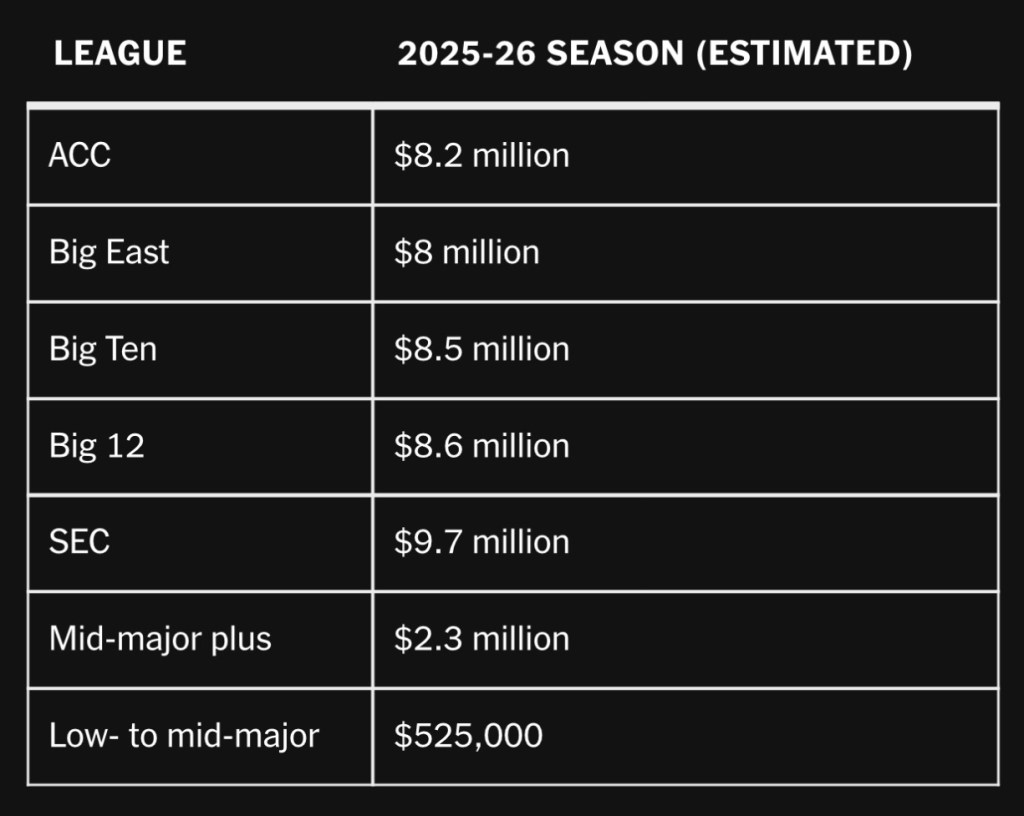
💰 Basketball budgets are ballooning.
In the ACC alone, there’s reportedly an eight-figure gap between the highest- and lowest-spending programs.
This era has redefined what it costs to “build a roster.” And as The Athletic highlighted, these costs are no longer solely covered by boosters and collectives — they’re now partially institutionalized through revenue sharing.
🧠 What This Means for Parents, Recruits, and Fans
The average parent of a student-athlete has no idea how complex this ecosystem has become. NIL, collectives, clearinghouses, caps, revenue splits — it’s a lot to digest. But understanding the foundation of this new economy is vital.
- 📌 This isn’t just about players getting “paid.” It’s about how, when, and who controls the funds.
- 📌 Revenue sharing may create more structure, but also introduces risk, regulation, and deeper disparitybetween programs.
- 📌 NIL Go could potentially flag or reject massive third-party deals, shifting power back toward schools and conferences.
🧾 Final Takeaway
This briefing isn’t a full recap of The Athletic’s piece, but rather a spotlight on the key issues reshaping college basketball as we know it. At Unit 1 Hoop Source, we’ll continue tracking how these policies evolve — and how they impact the future of grassroots development, recruiting, coaching stability, and player freedom.
One thing’s for sure: we’re watching a new college basketball economy being built in real time.
🔗 Full article by The Athletic → Click here
—
🧠 For more clarity, breakdowns, and scouting from the world of grassroots and college basketball, stay locked in to Unit 1 Hoop Source.
📬 Subscribe to the newsletter → unit1hoopsource.substack.com
🌐 Full site → www.u1hoops.com
📲 Follow us on X/Twitter & IG → @Unit1HoopSource
Editorial & Copyright Disclaimer
Unit 1 Hoop Source
All evaluations and written content published by Unit 1 Hoop Source are based on firsthand observation, verified film study, statistical review, and independent journalistic judgment. Evaluations reflect opinions at the time of publication and may evolve as additional film, data, and competition are reviewed.
Unit 1 Hoop Source is an independent basketball journalism and scouting platform. Content is for informational and evaluative purposes only and does not represent official views of any league, team, or agency.
© 2026 Kim Muhammad | Unit 1 Hoop Source. All Rights Reserved.
All content is protected under U.S. Copyright Law (Title 17). No material may be reproduced, republished, or distributed without prior written consent.
Contact: u1hoop@gmail.com
 Unit 1 Hoop Source