
Scouting Snapshot
Name: Jacob “Juice” Bannarbie
Position: Forward / Center
Height: 6’9”
Weight: 235 lbs
Class: Sophomore (Redshirt)
Previous School: UNLV
Hometown: Anchorage, Alaska / Encinitas, California
Introduction
In a transfer portal era driven by production and perception, Jacob Bannarbie enters the market as a player who requires proper evaluation context.
This is not a volume scorer. This is not a system-driven stat producer.
This is a role-based frontcourt piece whose value is rooted in physicality, efficiency, and functional impact within structure.
Bannarbie’s jump from limited minutes as a redshirt freshman to a consistent rotational presence at UNLV reflects something that does not always show up in headline numbers—trust earned through role discipline and consistency.
👉 Truth Statement: He is not a player you evaluate by what he doesn’t do offensively—he is a player you evaluate by how cleanly he executes what is asked of him.
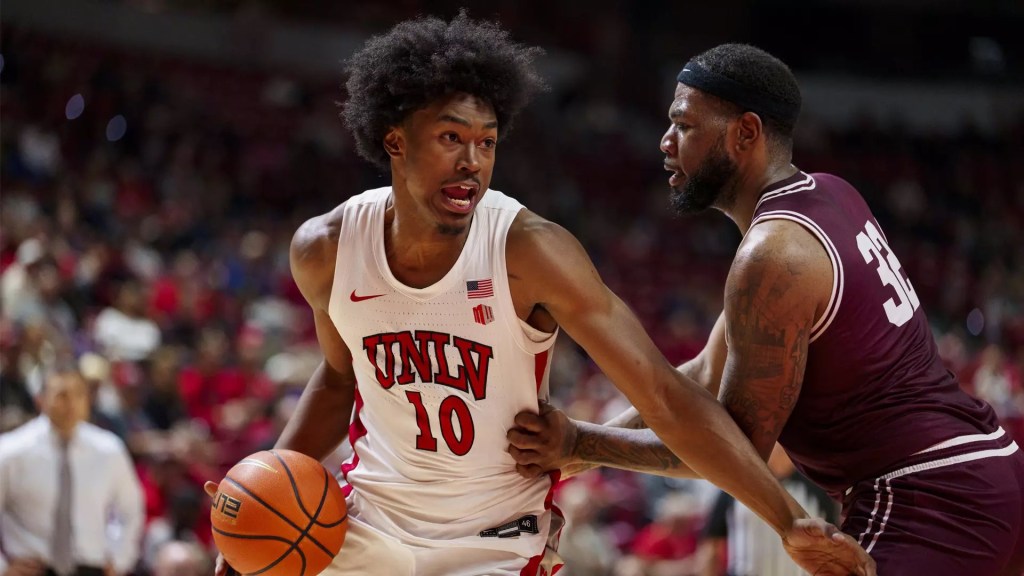
Verified Production (2025–26 Season — UNLV)
- Games: 30
- Minutes: 16.2 MPG
- Points: 5.4 PPG
- Rebounds: 4.8 RPG
- Assists: 1.3 APG
- Steals: 0.6 SPG
- Blocks: 0.4 BPG
- FG%: 51.9%
- FT%: 63.0%
📌 Notable Performances
- 15 REB / 5 AST vs Grand Canyon
- 15 PTS vs Nevada
- 12 PTS / 11 REB vs Saint Joseph’s
Scouting Breakdown
Bannarbie’s game is built on function over flash.
Offensively, he operates almost exclusively inside the arc, producing through:
- Interior positioning
- Timely cuts
- Offensive rebounding
- High-percentage finishing
He is a low-usage, high-efficiency finisher who does not require touches to impact the game.
👉 Truth Statement: He does not create offense—but he also does not stall it. And that distinction separates functional players from empty-usage players.
The assist numbers (1.3 APG) are not headline-worthy, but they are evaluation-relevant. His ability to make simple, correct reads—particularly in short-roll or interior touch situations—adds value in structured systems.
On the glass, his production translates. Nearly 5 rebounds in 16 minutes reflects activity, positioning, and willingness to engage physically.
Defensively, his impact is more positional than disruptive. He competes, bodies, and occupies space, but is not currently a high-level rim deterrent.
Strengths
✔️ Interior Efficiency
- 51.9% FG
- Scores within structure, does not force attempts
✔️ Rebounding Presence & Physical Frame
- Productive in limited minutes
- Capable of impacting games through effort and positioning
✔️ Connective Passing (Functional Feel)
- 40 assists / 35 turnovers
- Keeps offense moving without overhandling
✔️ Role Discipline
- Understands how to play without usage
- Does not disrupt offensive flow
✔️ Development Curve
- Clear Year 1 → Year 2 progression
- Earned rotational trust
Areas for Growth
⚠️ No Current Floor-Spacer Profile
- Minimal perimeter attempts
- Offense remains interior-based
⚠️ Free Throw Consistency (63%)
- Needs improvement for reliability
⚠️ Limited Offensive Creation
- Not a self-generator
- Dependent on structure and play flow
⚠️ Defensive Ceiling
- More positional than playmaking
- Limited rim protection production
⚠️ Durability Monitoring
- Missed time with calf and back issues
Projection (Portal Evaluation — Elite Clarity)
Bannarbie projects clearly as a rotation-level frontcourt piece at the Division I level, with value tied to:
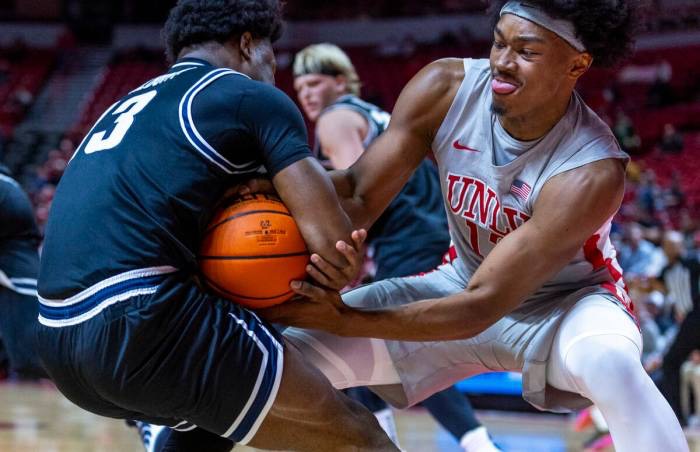
- Interior efficiency
- Rebounding
- Physical presence
- Role execution
He fits best in programs that:
- Emphasize structure over freedom
- Value possession control and efficiency
- Require frontcourt players to play within identity
👉 Truth Statement: Programs looking for production may pass—programs that understand roster construction will not.
He is not a plug-in scorer. He is a plug-in stabilizer.
Final Evaluation Take (9.5+ Level)
Bannarbie is not a player you build around—he is a player you win with in the margins.
His game is rooted in discipline, physicality, and efficiency, not offensive expansion. He does not command attention—but he consistently supports winning possessions.
He does not elevate an offense—but he does not break it either. And at this level, that carries real value.
The right fit will not ask him to become something else. The right fit will define his role clearly—and let him execute it consistently.
That’s where his game translates cleanest.
At Unit 1 Hoop Source, we don’t chase noise — we study film, define roles, and project truth.
Editorial Disclaimer (Unit 1 Hoop Source)
All evaluations, scouting reports, and features published by Unit 1 Hoop Source are based on firsthand observations, verified film review, and trusted sources. Our content reflects authentic, original journalism and is intended to provide accurate, fact-checked insight for players, families, coaches, and evaluators.
© 2026 Kim Muhammad | Unit 1 Hoop Source. All Rights Reserved.
This article and all written content on this platform are protected under U.S. Copyright Law (Title 17, United States Code).
No part of this material may be copied, reproduced, republished, distributed, or used in any form without prior written consent from the author. Violators will be subject to civil and criminal penalties.
For permissions or licensing inquiries, contact: u1hoop@gmail.com
 Unit 1 Hoop Source